No-Code vs. Custom-Coded MVP: Which One Should You Actually Choose?
Understand the trade-offs between no-code and custom development, and choose an MVP approach that fits your product, budget, and future plans.
Trynocode Team
Updated on September 23, 2026
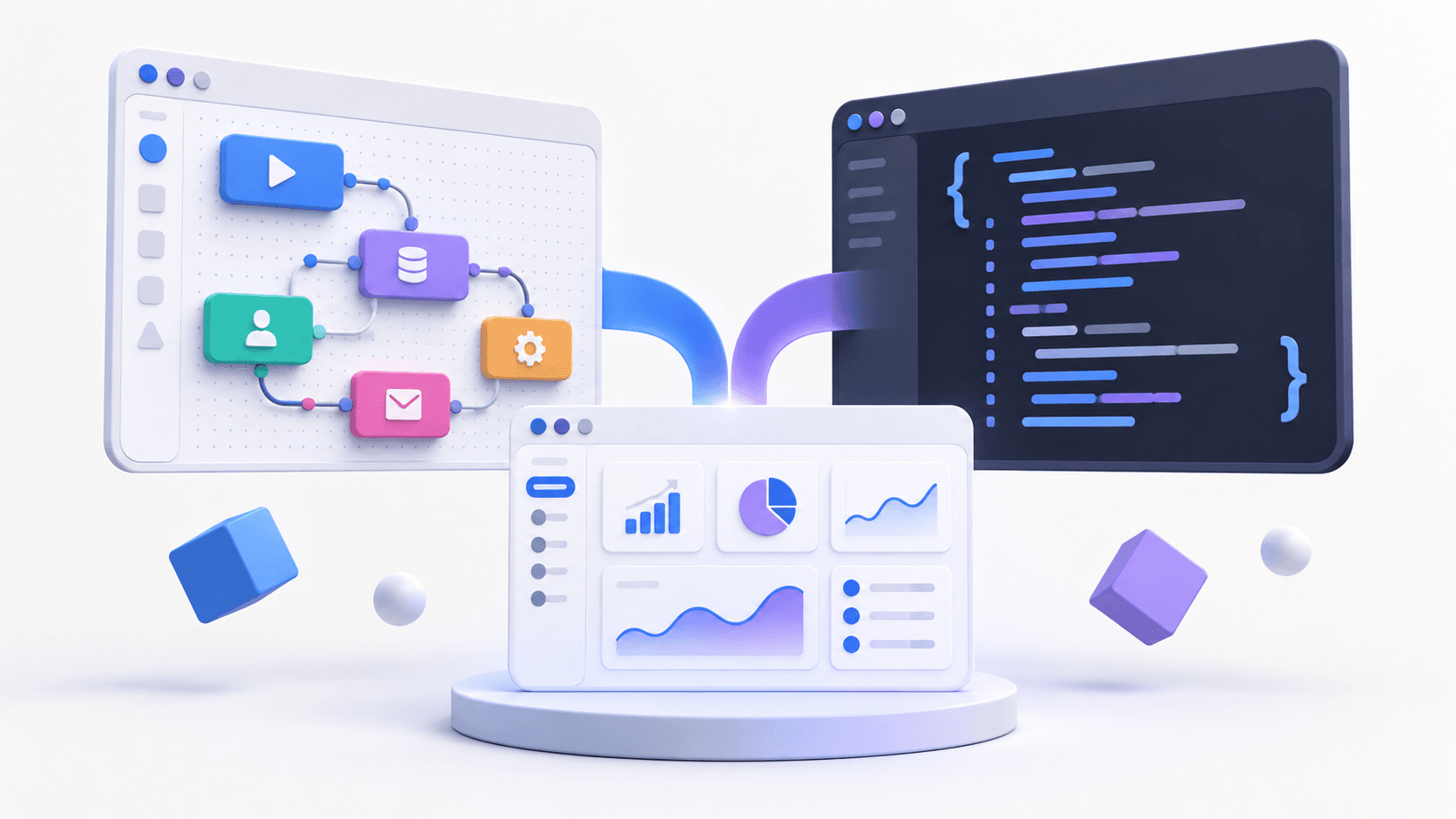
The creation of a Minimum Viable Product (MVP) is usually the first major step between having a business idea and showing the product to actual users. However, before developing the MVP, the founders need to make an important decision about whether to create the MVP on a no-code platform or with custom code.
There isn’t one answer that fits all cases. It depends entirely on your budget, time available, complexity of the product, expected scale, and future plans. An MVP built using no-code technology will allow you to validate your concept rapidly, whereas a custom-coded MVP will give you more flexibility.
Understanding the differences can enable you to select an approach that suits your product instead of opting for the technology that appears easiest.
What Is a No-Code MVP?
A no-code MVP is an MVP that is developed using a visual development tool instead of developing code traditionally. The developers or founders do not write code; instead, they use tools such as the visual editor, pre-built blocks, workflows, databases, and integrations to develop their products.
The platforms like Bubble, FlutterFlow, Webflow, and others have different capabilities. Some platforms specialize in website building, whereas other platforms allow for application logic, databases, API, authentication, and even mobile app development.
Just because a product is no-code does not mean that there is no logic in its development. A no-code app may still have user accounts, payment, a dashboard, database actions, automation, and integration. The main difference is that much of the coding is configured visually and not coded.
No-code is often used by startups to validate their ideas. In essence, a founder creates a viable version, shows it to potential customers, gets the feedback, and decides if the product deserves more investment.
What Is a Custom-Coded MVP?
A custom-built MVP is created using regular programming languages, frameworks, databases, and development tools. It is not developed by working on top of a no-code platform but through coding.
The technology stack is determined by the nature of the product being developed. A web app could consist of any number of combinations, including React, Node.js, Python, .NET, Java, etc., whereas mobile applications could be built with the help of Swift, Kotlin, React Native, Flutter, and so forth.
Custom development allows for more flexibility in the design and functioning of the application. Developers are able to develop very specific workflows, integrations, security protocols, and other performance characteristics without being limited to what one no-code platform offers.
However, the drawback to this approach is that custom development tends to be more time-consuming and costly.
No-Code vs. Custom-Coded MVP: Key Differences
The most important differences are related to speed, cost, control, scalability, and technical requirements.
| Factor | No-Code MVP | Custom-Coded MVP |
|---|---|---|
| Development speed | Generally faster because of visual tools and pre-built components | Usually takes longer because features are developed from the ground up |
| Initial cost | Usually lower, particularly for simple products | Generally higher because of development and engineering costs |
| Scalability | Can support growth, but depends on the platform and architecture | Greater control over scaling strategy and infrastructure |
| Customization | Good within platform capabilities | Extensive customization is possible |
| Performance | Depends on platform architecture and application design | Developers have greater control over performance optimization |
| Security | Platform provides much of the underlying infrastructure, but application configuration still matters | Greater control, but security becomes a larger development responsibility |
| Maintenance | Platform handles much of the infrastructure | Development team is responsible for ongoing maintenance |
| Integrations | Depends on available plugins, APIs, and connectors | APIs and custom integrations can be developed as required |
| Technical expertise | Lower barrier to entry, although complex apps still benefit from experienced builders | Requires experienced developers |
| Long-term flexibility | Can be affected by platform limitations and dependency | Generally offers greater technical flexibility |
The table provides a general comparison. The actual difference depends on the platform, development team, application architecture, and complexity of the product.
No-Code MVP: Pros and Cons
Pros of a No-Code MVP
The greatest benefit of no-code development is the speed. The use of pre-designed elements and a visual design tool may help minimize the time spent on developing the product. This approach is helpful when the key goal is testing an idea and not implementing all features.
No-code can also minimize upfront costs. The company can create a small version of the product without immediately putting together an entire team of engineers. This way, the whole budget can go towards marketing, research, design, and other initial tasks.
It is also easier to test and iterate on them. When the user gives feedback, founders can change aspects such as the workflow, interface, or features without having to completely redo a portion of the existing codebase.
Another benefit is less dependence on technology for simple apps. Business groups that have some knowledge of technology can handle parts of the application themselves, but more complicated apps will need no-code developers.
Cons of a No-Code MVP
However, the major disadvantage is that you are limited by the functionalities and features of the platform itself. Therefore, if the product you want to create relies on functionality that the platform lacks, the implementation might be difficult.
Scalability considerations are also necessary. While many no-code platforms are capable of handling large-scale use, performance and cost efficiency at scale depend on the architecture of the platform itself, workload model, and application design.
Platform dependence is another disadvantage. You are dependent on the service provider's pricing, services, policies, infrastructure, and even its availability.
Advanced customization will be more complicated depending on the complexity of the product. The simplicity of customizing a feature in the beginning will become more and more complicated as the application develops.
Custom-Coded MVP: Pros and Cons
Pros of a Custom-Coded MVP
The most significant strength of custom development is control. The developers get to decide the architecture, programming languages, database technologies, infrastructure, and development methodologies that fit the product well.
Custom coding is most effective in applications that have a high degree of business logic or a specialized workflow. Programmers are able to develop specific functionality based on the needs of the application.
The custom development approach could give more room for maneuvering in the future. If the application is supposed to be a sophisticated product in the future, then having the ability to manipulate the system could give some ease in the future development easier.
Cons of a Custom-Coded MVP
The only drawback is the initial high cost. You require professional developers who will develop, deploy, and maintain the application for you.
Also, custom development usually takes more time. A relatively simple MVP involves a lot of processes like frontend, backend, database, authentication, deployment, and security.
Maintenance is another factor that must be taken into account. In the case of a no-code platform, a lot of maintenance related to the technical side of things is provided by the service provider. However, when you develop a custom application, you need to perform all the maintenance yourself.
When Should You Choose a No-Code MVP?
A no-code MVP is appropriate if speed is a critical factor for you. When you have an entrepreneurial idea that requires rapid testing among actual customers, creating a smaller-scale project on a no-code development platform could help gather some constructive feedback before investing in bigger efforts.
This approach may be suitable even if you have a small budget. Rather than allocating significant funds toward developing the whole application, you can invest in just those capabilities necessary for testing your hypotheses.
The no-code platform is well-suited in situations where product needs are fairly simple. The appropriate product could be a marketplace, an internal dashboard, a simple SaaS product, a booking site, a community app, or even a workflow tool.
The method is particularly suited to the task at hand, since you aim to achieve market-product fit, not create the full product yet.
When Should You Choose a Custom-Coded MVP?
The process of custom development becomes more relevant when the business logic of the product is too complicated for implementation via a no-code platform.
It might also be the better choice for you if you need a lot of customization in terms of workflow and functionality. If a particular software must integrate with several other proprietary systems, it is a good idea to have full control over its architecture and APIs.
Another thing to take into account is specific performance needs. Applications with complex calculations, unique features, or any other special technical needs may require customized development.
You should also take into account the anticipated future for your product. If you already know that the solution is going to be heavily customized, technical control is going to be very high, or the architecture is going to undergo drastic changes in the future, then it makes sense to start with custom development from day one.
That's exactly the kind of project TryNoCode's custom MVP software development services are built for.
Can You Start With No-Code and Move to Custom Code Later?
Of course, the transition from the no-code MVP to a custom-coded application could be rational. Actually, there are startup teams who follow this path consciously in order to prove their business model first.
Migration is made more appealing when there is a proven demand for the product, the limitations of the no-code solution become apparent, or the size and requirements of the application have shifted.
But migration is not always easy. The data structure, workflows, integration, and business logic behind a no-code app have to be recreated in a totally different environment. Migration of data can also be challenging if the initial data structure was not built with migration in mind.
This is exactly why future needs must be taken into account when developing the very first MVP. Maintain good data structure, document necessary business logic, avoid unneeded platform-specific details, and know how key integrations operate.
So, Which MVP Approach Should You Choose?
The choice of no-code/custom coded development should be guided by the product rather than technology.
When your main aim is to validate a concept fast, operate with minimal funding, and test simple functionalities, then a no-code MVP can serve as an ideal base for you to start from.
Where the product necessitates complex business logic, unique features, integration capabilities, performance needs, or control for an extended period of time, it may make more sense to consider custom software development.
The solution to the problem could also lie in utilizing both approaches at once. A no-code MVP will determine the desire of customers for such products, and the custom development can follow once there is sufficient reason to make this decision.
Still weighing your options? TryNoCode's MVP development services team can walk you through both paths and help you land on the right one for your product.
But the key question here is not, "Which technology is better?" The right question is "What does my product require now and what will be required of it when it succeeds?" Finding the answer to this question will make it easier to select the most appropriate MVP development approach for you.